Table of Contents
Conversion Rate Optimization in 2026: 10 Strategies to Improve Website Conversions
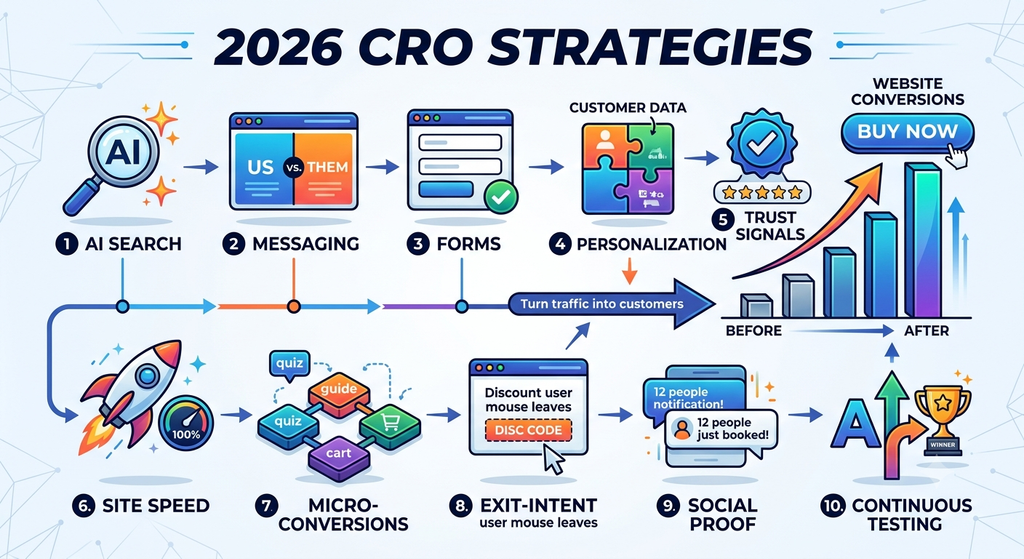
Attracting people to your website is just the first step. The bigger challenge in 2026 is converting those visitors into leads, customers, and long-term buyers. As AI-powered search features continue to influence website clicks and users become more selective with their attention, businesses need to focus on getting better results from their existing traffic. CRO helps businesses improve website experiences and encourage visitors to take valuable actions. In this guide, we’ll explore ten practical strategies to increase conversions from your current audience, followed by answers to some of the most frequently asked questions about CRO in 2026.
1. Optimize for AI-Driven Search Results
AI overviews now sit above traditional search listings for most queries, meaning fewer people click through to websites — but those who do tend to be further along in their decision journey. Your landing pages need to answer the visitor’s core question within the first screen, then move them toward action quickly. Avoid long, generic introductions; a visitor who clicked past an AI summary is looking for depth or a clear next step, not a repeat of what they already read.
2. Perfect Your Above-the-Fold Messaging
Visitors decide whether to stay or leave within seconds of landing on a page. Your headline and subheading should instantly answer three things: what you offer, who it’s for, and why it matters right now. Skip clever wordplay that requires extra thought. Run A/B tests on your headline and hero section regularly — modern testing tools make this easy and affordable, even for small businesses.
3. Simplify Forms and Checkout Flows
Every extra field in a form reduces the chance someone completes it. Review each form and ask whether the field is truly necessary at this stage, or whether it can be collected later. Progressive profiling — gathering minimal details upfront and more over time — consistently outperforms long forms. For online stores, guest checkout, autofill, and visible progress bars during multi-step checkouts remain some of the easiest wins available.
4. Personalize Based on Behavior, Not Just Demographics
Generic personalization no longer stands out. What works now is behavioral personalization: showing returning visitors content related to what they browsed before, adjusting CTAs for first-time versus repeat visitors, and tailoring messaging to the traffic source. A visitor coming from a comparison search has different needs than one searching your brand name directly — meet each of them where they are.
5. Embed Trust Signals Where Hesitation Happens
As AI-generated content makes people more cautious online, trust has become a major conversion barrier. Place trust signals exactly at the point of hesitation, not just on a separate testimonials page. Real client photos, verified review counts, security badges near payment fields, and specific results (“42 new leads in 60 days” rather than “great results”) all reduce last-minute doubt.
6. Prioritize Site Speed
Page speed directly affects conversions, not just search rankings. A slow-loading website can make visitors leave before they discover your offer. Compress images, lazy-load non-essential elements, cut unnecessary third-party scripts, and test performance on mid-range mobile devices rather than a fast office connection. In mobile-heavy markets, this alone can outperform a full site redesign.
7. Design for Smaller Commitments, Not Just the Final Sale
Not every visitor is ready to buy immediately. Instead of optimizing only for the final purchase, create smaller conversion points: downloading a guide, taking a quiz, saving an item, or joining a waitlist. These micro-conversions capture intent from visitors who aren’t ready to commit fully, giving you a way to re-engage them later through email or retargeting.
8. Use Exit-Intent Offers Strategically
Exit-intent popups have a poor reputation because they’re often overused. Done well, they still work. The key is precision — trigger offers based on real behavior like scroll depth, time on page, or cart abandonment, rather than showing the same popup to everyone after five seconds. A relevant, well-timed offer can recover conversions that would otherwise be lost.
9. Show Real-Time Social Proof
Static testimonials help, but real-time proof — “12 people booked this service today” — taps into urgency more effectively. This must be genuine; fabricated urgency damages trust once noticed, and audiences in 2026 are quick to spot it. Used honestly, real-time proof performs particularly well on service pages and appointment-based businesses.
10. Test Continuously
The biggest CRO mistake is treating optimization as a one-time project. User expectations, competitor offers, and market conditions shift constantly, so a page that converted well six months ago may already be underperforming. Build a simple monthly testing habit: pick one page or element, form a hypothesis from data, run the test, and implement the winner. Small, consistent improvements compound faster than one annual redesign.
Frequently Asked Questions
Q1: What is conversion rate optimization (CRO)?
CRO focuses on improving the number of website visitors who complete a specific goal, such as purchasing a product, submitting a form, or registering, without requiring more traffic.
Q2: What’s a good conversion rate in 2026?
It varies heavily by industry, traffic source, and offer type. Rather than chasing an industry average, focus on consistently improving your own baseline through testing.
Q3: How is AI search changing CRO strategy?
Because AI search summaries are driving fewer but higher-intent visitors to websites, your pages must offer immediate value. As a freelance digital marketer in Alappuzha, I can help you create clear next steps for visitors who arrive ready to make a decision.
Q4: What’s the fastest way to improve conversions with limited resources?
Start with page speed and form friction. Both are usually quick to fix, don’t require a redesign, and tend to produce measurable improvements within weeks.
Q6: How often should I run CRO tests?
Ongoing is better than occasional. A monthly cadence — testing one page or element at a time based on data — tends to produce steadier, more reliable gains than infrequent large-scale changes.
Q7: Is personalization worth the investment for small businesses?
Yes, even simple behavioral personalization — like adjusting CTAs based on traffic source or showing different messaging to returning visitors — can meaningfully improve conversions without requiring advanced tools or large budgets.
Final Thoughts
CRO in 2026 isn’t about chasing every new tactic that appears — it’s about removing friction, building real trust, and meeting visitors where their intent already is. Start with the fundamentals: fast pages, clear messaging, and simple forms. Layer in personalization and honest social proof once those basics are solid, then commit to continuous, small-scale testing rather than one big overhaul. Businesses that consistently convert the traffic they already have will always outperform those simply chasing more of it.